December 13, 2013

Lambic Brew Day and Bottle Release


On January 24th, 2014 Funk Factory Geuzeria will be brewing a traditional lambic with O’so Brewing. After 2 years of “practice” and dialing in the Turbid Mash process, we now have a 1,000 gallon capacity Coolship and will be able to spontaneously ferment our Lambic!

To celebrate, we will have 4 limited-release sour and funky beers available for sale at 5:00pm. We invite beer lovers to come watch the coolship filling at the O’so Tap House and pick up these limited bottles. Cheers!

Facebook Event Page
O’so Tap House
3028 Village Park,
Plover, WI


Dweller on the Threshold - 5.25% ABV - Blended American Sour - 450 bottles
Artwork for this label was done by Amy Swoboda and kicks off our "Fermentation is Art" series. In this series we will commission artists to create original pieces of art inspired by the concept of the beer. Amy is a Cincinnati artist and will be at the release selling 25 signed and numbered prints of the original artwork. First come first serve. Proceeds from this bottle will help Funk Factory pay for the coolship. Thank you for your support!

Sikaru - 12.75% ABV - American Sour with Dates - 430 bottles


Scarlet Letter - 5.5% ABV - Cranberry Sour Blonde - 360 bottles


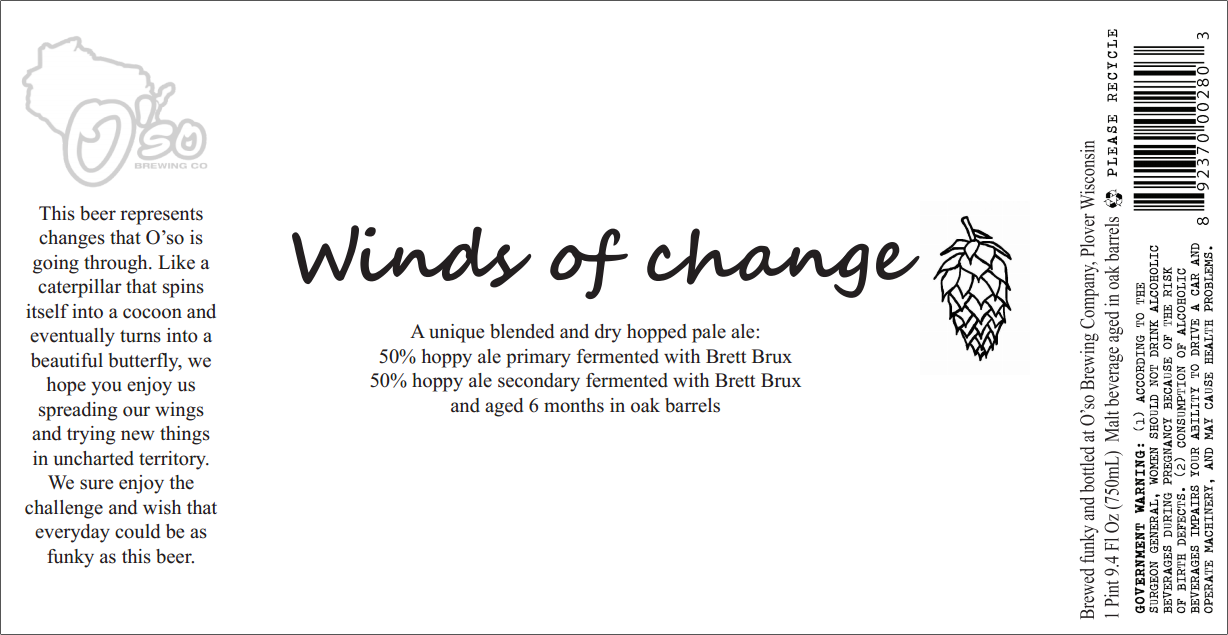
Winds of Change - 5.5% ABV - American Pale Ale with Brett - 3,000 bottles

September 13, 2013

Cider Keeve: Day 270

We are just about at the 9 month mark from when I started the cider keeve experiment.  It was bottled at the 6 month mark and so has been conditioning in the bottle for the last 3 months.  As a recap, "keeving" is an old French cider making process that removes nutrients from the cider.  This results in a slow fermenting environment in which I applied lambic yeast/bacteria with the goal of emulating a typical lambic fermentation in cider, and it worked.

When I bottled the cider, I anticipated it would take up to 3 months to carbonate as that is common amongst lambics.  I opened a bottle after about a month and a half, and it was dead still.  Though slightly worried, I gave it some more time.  Last night, as we approach the 3 month mark, I opened a bottle to check on it. The cork was stubborn, but came out with a faint "psht".  No head formed as I poured the cider, but some bubbles did accumulate briefly on the side of my glass.

It is not nearly as carbonated as I would like, but nice to see something form.  I will continue to let this condition, but am thinking about how to correct this for next time.  The critical element in this cider is that there is a lack of nutrients.  While this is beneficial to getting saccharomyces and brettanomyces to ferment in tandem, at the point of bottling, I am afraid that there just isn't enough nutrients to properly carbonate the cider.  Next time I might try adding some yeast nutrients along with the priming sugar.

The cider is a very pretty color and crystal clean when poured in a glass. There is, however, some yeast sediment that accumulated at the bottom of the bottle during conditioning. Because of how crystal clear this is, I think the riddling and disgorging process of Champagne might make a nice finish.  Its a lot of work, but I might consider doing this on part or all of the next batch.

The plan as of now is to fill 2 barrels with keeved cider juice and ferment it the same way this batch was done.  Adding barrel aging and fermentation will certainly be beneficial, but this has to be one of the most labor intensive and expensive ciders to produce.  Custom pressing, risky keeving process, lambic-style fermentation, extended barrel aging, long bottle conditioning time, and possibly adding riddling/disgorging finish....yikes.  At least the final result is worth it!

Aroma:  Smells of apples and pears.  There is a brett funk that is subtle but definitely noticeable.

Appearance: Very attractive appearance.  Crystal clear with some bubbles forming ever so slightly.  I can imagine this would be beautiful with bubbles cascading up.

Taste:  Apple "juice" flavor is very mellow, but the apple skin tannin flavor is more pronounced.  I am pleasantly surprised with how tart it got. Earthy and musty flavors are the biggest contributions from the brett.  As I said earlier, I think Brett brux dominated the fermentation.  I used a Wyeast smack pack this time, but next time I will definitely be sourcing a lambic blend from East Coast Yeast and hope to have a more diverse brett presence.

Palate: Again, the carbonation is still low at this point, so it is not as effervescent as I targeted.  Aside from that, there is a great body on the cider.  It is light and fresh without feeling thin.

Overall: I am very happy with how balanced and funky this cider is.  I am thrilled that the experiment worked and look forward to making some slight refining shifts when we produce a lot more of this.  I think barrel aging will add a lot of complementing aroma and flavor characters, but even as is this is a very nice cider with a lot going on.  I'm looking forward to seeing how it continues to develop in the bottle.

August 21, 2013

Site updates & side projects

Many of you have probably already noticed, but I have been making a few updates to the site.  Most noticeably, I finally ponied up the ~$10 and registered a domain.  All of the old links you may have saved will still work, but instead of showing up to a ".blogspot.com/..." domain, you will be redirected to "funkfactorygeuzeria.com/...".

Next, I've split the cider related projects from the rest of the posts.  At the top bar you will see Home, Lambic, and Cider.  Blogspot, as of yet, doesn't allow for actually posting to different pages, so this is a little work around.  Home is everything, Lambic is everything non-cider, and Cider is obviously all cider related posts.  Additionally, I've added a direct link to the Brett Strain Guide up there.

I've also created a Facebook page for the site. I'd like to keep the main site clean and resource focused, so for the little things that occur that don't quite warrant a blog post, I'll be using Facebook. Also, all of the posts from here on out will show up on the Facebook page. If you are on Facebook, you can click the "like" button on the right side bar. -->

While we wait another year for the barrels to be old enough to start making fruited lambic, I have re-attempted making Sikaru with some young barrels.  A couple months ago, 200lbs of organic dates were shipped to the brewery where I selected the two most mature barrels from batch 1 (which is 1 year old).  We pitted 30% of the dates and added 100lbs of dates to each barrel.  My original thought was to let these ferment in the barrel for the typical 3 months, but after discovering how much sugar dates contain, it may take longer for these barrels to finish fermenting!

The other side project going on is a sour blonde.  The yield from our batch 2 brewday was not as high as the first batch (winter vs summer), and so two of the emptied lambic barrels from racking over batch 1 were not filled with new lambic wort.  To make use of these barrels we filled them with Blonde Ale wort and allowed the bugs in the barrel to ferment the beer. After aging for 6 months these barrels are ready.  To make room for a fruit addition, some of the base beer was kegged. A sample of it showed up at Great Taste and will show up at future O'so events. The rest of it will be fruited in the barrels and eventually bottled.

Keep your eyes open (or watch the FB page for updates), these small side projects should be available this fall/winter.

June 24, 2013

Cider Fermentation Panel: Bottling & Tasting

06/24/13

Last weekend I met the guys at Leidel's orchard for a final taste and to bottle the ciders.  I'm glad we tasted these again as there are some big differences on a few batches.  We purposefully didn't look up our old tasting notes and only compared after we had re-tasted them all and made new notes.  Here are our notes from this session:

  1. Brett drie (BSI)
    - some tartness, light, crisp, refreshing, although a bit thin.
  2. Brett custersianus
    - sweet, tropical, pineapple/mango, nice body.
  3. Brett nanus
    - barnyard and pineapple aroma, tastes strongly of pineapple juice. great flavor, but kind of intense.
  4. Brett lambicus (wyeast)
    - not flavorful, watery.  slightly cheesy and tart.
  5. Brett bruxellensis (wyeast)
    - very flavorful. pear, melon, citrus and a bit of alcohol.
  6. Brett claussenii (WL)
    - pungent aroma, citrus, floral, and dry.  saison-like.
  7. Brett fantome
    - pretty good mouthfeel.  complex, tart apple, a very soft blue-cheese like funk (good), nice funky aroma.
  8. Saccharomyces paradoxus
    - watery, slight funk and citrus.
  9. Brett blend
    - got a lot going on, but not very flavorful as a whole.  funky, fruity, citrus.
  10. Brett blend and oenococcus
    - muted flavor as compared to #9.  The acidity was mellowed, and so I see there may be potential value in this addition, but likely only as a secondary fermentation, or partial blend.
  11. Brett blend with maltodextrin addition
    - As compared to #9, a bit drier of a finish, thicker body, more robust flavor. a bit more alcohol.
We decided only Drie, Custer, Nanus, Brux, Claussenii, and Fantome were worth bottling.  The plan is to open these bottles over the summer and get a good understanding of each strain and how they may develop now that they are off the traub. For larger production this fall, we will be making a couple blends from the strains we like best.

Some interesting information comes in comparing our notes from the sampling we did a month ago.  The biggest changes were in Nanus and Claussenii.  A month ago Nanus tasted of rotting fruit and cheese.  It wasn't even drinkable, but now it was one of our favorites and had a huge pineapple flavor.  Claussenii was very stale in flavor, but now has a beautiful floral/citrus flavor.  

If you are looking to brew a brett cider, it is important to note that brettanomyces continues working even after fermentation has completed and it may take a couple months to develop the desired flavor.  For those homebrewers who don't want to wait more than a month, I would recommend Wyeast's B. bruxellensis (note: this is different than White Lab's) as it had a great flavor profile in both tasting sessions and is an easy strain to obtain.

On a side note, I also bottled up my Cider Keeve and Foraged Farmhouse the previous weekend.  More on that coming soon...
Bottled cider keeve.
Bottled Cider Keeve.

June 17, 2013

Brett Strain Guide

Brandon at EmbraceTheFunk.com and I have put together this Guide for all of the brett strains we know of out there.  As new strains come out, we will be updating the list.  A big thank you to Al Buck at East Coast Yeast for helping with much of the taxonomy and history of the strains.


Hopefully this helps clear the confusion out there about the different strains and their relationship to each other.

May 19, 2013

Cider Fermentation Panel: Tasting

I met with the guys at Leidel's orchard agian last weekend to check in on the wild cider fermentation experiments.  We took gravity readings and sampled each batch.  Here are the results:
  1. Brett drie (BSI) - 1.000
    - orange peal, citrus, tropical fruit, pineapple, tingling feeling on the sides of the tongue. 
  2. Brett custersianus - 0.999
    - lemonade like citrus, cherry, white wine, flavor not intense, but pleasant.  slightly watery.
  3. Brett nanus - 0.998
    - overripe/rotting fruit, cheesy, not pleasant. 
  4. Brett lambicus (wyeast) - 0.995
    - grassy/woody, watery flavor, tingly.
  5. Brett bruxellensis (wyeast) - 0.999
    - hay and floral funk with sweet nectarine. 
  6. Brett claussenii (WL) - 0.998
    - light citrus, watery, yeasty.
  7. Brett fantome (ECY) - 0.998
    - hay funk, green apple tartness, tingly.
  8. Saccharomyces paradoxus - 0.998
    - buttery Chardonnay, candy sweetness.
  9. Brett blend (drie, claussenii, fantome, ECY05) - 0.998
    - light citrus
  10. Brett blend and oenococcus - 0.995
    - as compared to #9, less tart and more alcoholic.  less flavor.  watery.
  11. Brett blend with maltodextrin addition - 0.996
    - as compared to #9, smooth/creamy feel and more flavorful.
We didn't bottle as this was the only gravity reading I have and don't know what the FG will be for any of these.  Normally you might think 1.000 is a safe number, but having batches at 0.995 makes me cautious.

The base cider we used was intentionally a neutral and lacking flavor.  This allowed us to more easily pick out the flavor of the yeast only.  As you can see from the Brett fantome batch, we could taste a green apple flavor and know that it wasn't from the base cider, but rather the yeast.   So while this was beneficial, I think its important to note that the base cider wasn't very flavorful and led to some batches tasting "watery".  This might be better stated "the yeast strain didn't produce a very large amount of flavor".  With a different base cider blend, these may still be viable strains for producing tasty cider.

It was very interesting to feel this tingling sensation on the sides of my tongue from some batches.  I have no idea what that is and have never experienced it before.  Future batches are required to see if this is something brett does in cider.

Batches #10 and #11 are worth talking about more.  While we were experiencing some palette fatigue, it was easy to compare them against #9 and see the impact from the addition of oenococcus and maltodextrin in cider.  Quite simply, oenococcus wrecked the brett fermentation while maltodextrin enhanced it.  I was skeptical that maltodextrin would do anything as I knew the brett would eat it away, but it does seem to have helped both the mouthfeel and the flavor.

The favorite batches were drie, custersianus, bruxellensis, fantome and paradoxus.  I already feel like I want to revisit some of these strains, so I am going to hold off final judgement until I taste these a few times.  Also, I'm looking forward to tasting them once carbonated, but it will be a few weeks before I have another chance to get up there and bottle.

May 9, 2013

Foraged Farmhouse

Its been nearly 10 months since I started the "minimalist lambic".  I've tasted it here and there, and unsurprisingly the beer is fairly simple.  The main flavors I get from it are barnyard funk, bitterness, and lemon rind acidity.  The barnyard flavor isn't the horse-blanket funk, but rather a softer more earthy/floral barnyard.  It reminds me more of the funk you get from brett farmhouse beers.

With that in mind, I had decided that I should run with the earthy/floral flavor and add some dandelions.  Its not my personal favorite, but thought it could add some complexity and make a nice summer sour beer for my wife.  When I went out to pick some dandelions, I noticed maple flowers blooming above me.  I had been told just the night before that these are edible, so I decided to try some.  Turns out they are pretty good.  I picked two varieties; Sugar Maple and Norway Maple.  Ironically, the Norway Maple flowers are much sweeter than the Sugar Maple's.

Sugar Maple flowers.

Norway Maple flowers.

Eating them raw is fine, but I had no idea how they would translate into a beer.  I decided to take a pinch of each and make a tea with them to get an idea of how strong the flavors would be.

Teas made with maple flowers and dandelions.
I found I preferred the flavor of the Norway maple flowers the most, but they both make pretty good tea.  I sorted out and added about 2 cups of Norway maple flowers, 1 cup of Sugar maple flowers.  The dandelion tea seemed to be a bit vegetal, which I attributed to the green bottom of the flower, so cut that part off of each and added 1/2 cup of dandelion flowers (petals?).

Bowl of ingredients ready to be added to the beer.
I also decided to add 4oz (~1 cup) of dried cranberries.  I'm not looking to pick up cranberry flavor in the end, but rather just a soft fruity note.  Also I thought it would help the color of the beer.

I'm thinking I'll give these about a month to infuse with the beer and then it'll be ready for bottling.  With any luck, it will be a nice summer beer.

Google Analytics