My barrel of "Sikaru" that I added dates to on Day 22 has a problem; acetobacter. Acetobacter creates acetic acid, which in small amounts can be acceptable in lambic, but when oxygen is plentiful, the acetobacter will create too much. This is exactly what has happened.
About 4 months ago you may remember that I waxed this barrel fearing it was getting too much oxygen. I only waxed the top half where the head space is thinking the rest of the barrel should be fine. Well, I was wrong. This isn't to say you can't age a beer in a 5 gallon barrel. My problem is that I got this barrel (for free) when I bought the 60 gallon barrel from a local winery. He had kept the 5 gallon barrel on a display shelf for a couple years, so it was in very poor condition. It wouldn't even hold water. It took me a week to swell the barrel to a state that it could hold water. Before filling, I steam cleaned the barrel thoroughly. I assumed it was fine at that point, but I now believe the staves, while water tight, were not tight enough to slow O2 permeability sufficiently and there remained too much acetobacter in the wood even after the steaming process. If you are going to use a barrel (of any size) make sure it has been properly maintained. Also, if you are using a 5 or 10 gallon barrel, I would still recommend waxing the outsides to cut O2 permeation to a level comparable with the large 60 gallon barrels.
Last month I started a discussion on RateBeer talking about American Lambics vs. Belgian Lambics. In my opinion, a higher acetic acid flavor profile is the norm from American Lambic producers. It creates a more intensely sour flavored beer. With the relatively young lambic drinkers in America, there is a mind set that the more sour a beer is means the better the beer is. American brewers know this and some even keep a "sour barrel" handy that they blend into the final batch to increase the sour profile. However, Belgian Lambics do not have much of any acetic acid flavor in their lambics. I don't know if they go as far as to call it an off flavor, but I personally do. I don't care for it in my lambics.
At this point, this barrel is useless to me. With a healthy supply of O2, acetobacter will continue to convert alcohol into acetic acid. Allowed to continue, I will have vinegar. Maybe I'll make a mustard with it?

Showing posts with label sikaru. Show all posts
Showing posts with label sikaru. Show all posts
June 21, 2012

February 18, 2012
Barrel Notes: Day 22
I have checked in on the pellicle again as I am interested to see it during different stages of development. Here is a picture of its current state.

As compared to the picture in my previous post, it appears as if little colonies have developed. The aroma coming from the barrel is increasingly funky.
You may remember that in addition to the 225 liter barrel, I had enough wort left to fill a small 5 gallon barrel. To ferment the 5 gallon barrel, I used an assortment of commercial sour dregs collected at a beer tasting event. It is interesting to compare the pellicle formed in the big barrel (above) to that of this 5 gallon barrel (below).

There are a few major factors that cause such a different pellicle formation between the two barrels. The primary factor would be the different yeast source. Another factor is the 5 gallon barrel has higher oxidation due to greater surface area with the oak. In addition, there was only about 4 gallons remaining to fill the 5 gallon barrel, so it is a relatively short fill resulting in a larger head space. This head space has theoretically been filled with CO2 during the primary fermentation phase, however I do not doubt a certain amount of oxygen was present as well.
I don't want that much head space in the 5 gallon barrel during the aging process. After some consideration on what to do, my plan for this 5 gallon barrel is to make the Sikaru I talked about earlier. To do this, I will be adding dates and honey to the lambic. The rule of thumb in fruiting lambic is 2lbs of fruit per gallon of lambic, so I will be requiring 8-10 pounds of dates. Normally fruiting is done a few months prior to bottling, however, I will be adding a portion of the dates now to eliminate the unwanted head space in the barrel.

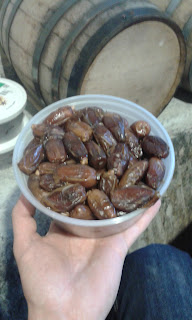
I purchased 4.5 pounds of whole dates. I'm not 100% sure the reason behind using whole fruits, however I know Cantillon and others insist on it, and so I made sure to follow suit.

I wanted to wait until primary fermentation had ended to add the fruit, but make sure they were added before the aging stage started. With the amount of sugar in dates, and the amount of dates I added, I wouldn't doubt if I saw a reasonably strong second fermentation. I'm not worried that I've damaged the existing pellicle (and of a second fermentation damaging it further). It was not dense enough to fall, and the disturbed area will grow back in short time.

As compared to the picture in my previous post, it appears as if little colonies have developed. The aroma coming from the barrel is increasingly funky.

You may remember that in addition to the 225 liter barrel, I had enough wort left to fill a small 5 gallon barrel. To ferment the 5 gallon barrel, I used an assortment of commercial sour dregs collected at a beer tasting event. It is interesting to compare the pellicle formed in the big barrel (above) to that of this 5 gallon barrel (below).

There are a few major factors that cause such a different pellicle formation between the two barrels. The primary factor would be the different yeast source. Another factor is the 5 gallon barrel has higher oxidation due to greater surface area with the oak. In addition, there was only about 4 gallons remaining to fill the 5 gallon barrel, so it is a relatively short fill resulting in a larger head space. This head space has theoretically been filled with CO2 during the primary fermentation phase, however I do not doubt a certain amount of oxygen was present as well.
I don't want that much head space in the 5 gallon barrel during the aging process. After some consideration on what to do, my plan for this 5 gallon barrel is to make the Sikaru I talked about earlier. To do this, I will be adding dates and honey to the lambic. The rule of thumb in fruiting lambic is 2lbs of fruit per gallon of lambic, so I will be requiring 8-10 pounds of dates. Normally fruiting is done a few months prior to bottling, however, I will be adding a portion of the dates now to eliminate the unwanted head space in the barrel.


I purchased 4.5 pounds of whole dates. I'm not 100% sure the reason behind using whole fruits, however I know Cantillon and others insist on it, and so I made sure to follow suit.

I wanted to wait until primary fermentation had ended to add the fruit, but make sure they were added before the aging stage started. With the amount of sugar in dates, and the amount of dates I added, I wouldn't doubt if I saw a reasonably strong second fermentation. I'm not worried that I've damaged the existing pellicle (and of a second fermentation damaging it further). It was not dense enough to fall, and the disturbed area will grow back in short time.
January 18, 2012
Sikaru
Sikaru was brewed thousands of years ago by one of the oldest known civilizations; the Sumerians. Like Lambic, Sikaru was spontaneously fermented, and brewed with a ratio of 35% wheat and 65% barley. In one writting, "A hymn to Ninkasi" (Ninkasi is their goddess of beer), the brewing process is outlined. A "beer dough" and malts were mixed together in pots of water and heated [Mash], then poured [Wort] through large reed mats to strain [Lauter] and cool [Coolship]. Ninkasi (goddess of beer) would then ferment [Spontaneous Fermentation] it into beer. It was then filtered and then put in large storage vats. Its incredible how similar that is to the Lambic brewing process. It was also commonly sweetened with dates and honey.
One difference you may notice is that they didn't use hops, but the hops used in Lambic are aged long enough to lose its flavor, and therefor only a preservative. I think I will have to try making a small batch of lambic with dates and honey and call it Sikaru. (Update: Sikaru is in the barrel)
One difference you may notice is that they didn't use hops, but the hops used in Lambic are aged long enough to lose its flavor, and therefor only a preservative. I think I will have to try making a small batch of lambic with dates and honey and call it Sikaru. (Update: Sikaru is in the barrel)
Subscribe to:
Posts (Atom)