September 21, 2012

Barrel Tap

[Update: It appears the threaded tapered tap is no longer being produced.  If you would like a barrel tap, RMBC has had these fabricated and should have them in stock]

I've got plenty of time before we empty the barrel up at O'so, but its never a bad idea to get ready.  Following instructions from Vinnie at Russian River, I drilled a 15/16th inch hole at the bottom of the head and plugged it with a standard Belgian cork; the drain port.  When Russian River is ready to drain the barrels, they pull the cork and jam a 1" hose into the hole.  While I am sure that works fine, I wanted a little easier and more secure way of draining the barrel.

First I got a threaded tapered tap from winetaps.eu that look like this:
threaded tapered tap

The sales rep called the one I wanted a "1/2 inch tap", which is the inside diameter of the tap.  The outside diameter of the taper goes from 22mm to 26mm (~7/8" to 1 1/16").  The drain port is 15/16", so it fits perfectly.  I tested it out on a scrap piece of wood, and the tap goes in about half way, and with a half turn, the thread lock the tap in place.

The back end of this piece had a BSP threaded connection.  Breweries, however, use almost exclusively Tri-Clover connections.  I figured it would be nearly impossible to find an adapter, and even if I did find it, I would be left with crevices that could hold unwanted bugs.  So, I ordered a 1" Tri-Clover ferrule from brewershardware.com:  (note: a 1" Tri-Clover still has the standard 1.5" clamp)
1" Tri-Clover ferrule
I then took the pieces to a machine shop to get them welded.  Its important to note that there is more than one way to weld Stainless Steel, but if you want it food-grade, you have to get someone that can TIG weld the pieces.  I also had the shop bore out the BSP threads from the original tap leaving a smooth, easy to clean, surface.

Threaded Tapered Stainless Steel Barrel Tap with 1.5" Tri-Clover Fitting
Threaded Tapered Stainless Steel Barrel Tap with 1.5" Tri-Clover Fitting.
With this final piece I will attach a shut-off valve.  Then when I pull the cork from the drain port, I can quickly push this piece in and give it a half turn to lock it in place.  Simply attach a tube to to the back of the shut-off and draining the barrels should be pretty easy.

September 2, 2012

O'so Collaboration: Day 50

I went back up to O'so yesterday to check on the barrels and install the sample port.  It has already been 50 days since we brewed the lambic!  Wow, time flies.  However, when you consider the beer will have to age close to 2 years, that isn't much time at all.  At this point in the game, it is more of a sensory check for off flavors.  I am expecting it to taste/smell essentially like a berliner weisse.  I was also curious if there would be any differences between the barrels.  There are 14 barrels, so hopefully they will develop differently and we will have some diversity to blend with.

installing the sample port
Drill a 7/64" hole and catch a sample
As expected, they all taste/smell like a berliner weisse, which is a good sign.  We are on the right track.  There wasn't a whole lot of variety (obviously it is still very young), but there was some.  Some barrels were more lemongrass, some were more minerally, some were more brett/funky.  Aside from tasting and smelling the beer, it is a good chance to take a gravity reading.  All the barrels we tested were hovering around 5 brix (1.009 SG).

taking a gravity reading
Testing gravity with a refractometer. 
All and all I am pretty happy with the progress.

July 18, 2012

Minimalist Lambic: Fermentation

We had some extra lambic wort at the end of the O'so brewday, so a few of us filled up carboys to take home.  Instead of buying a lambic blend yeast, I thought I would try something new; I wanted to try fermenting the wort as simply as possible.  The 4 main players in Lambic fermentation are Saccro, Brett, Lacto, and Pedio.  Between the two bacteria strains (Lacto & Pedio), I have read that Pedio does the lion's share of creating the acidity in Lambic, so I chose that one.  When Pedio is fermenting, it gives off diacetyl, which is a buttery off flavor.  Brett however eats the diacetyl compound and therefor should always be used in conjunction with Pedio.  So, between the two yeast options (Saccro & Brett), I really don't have a choice but to use Brett, although that is what I would have picked anyway.  The strain of Brett I picked was Brett Brux, as I like the barnyard funk flavors and thought it would complement fruit additions later on should I choose to add any.

I pitched the Brett & Pedio into my 6 gallon Better Bottle full of Lambic wort on Sunday.  On Tuesday noticeable fermentation started.  Here is what it looks like:
Lambic fermentation with only Brett B & Pedio
Once the primary settles down, I'll go put this next to my pilot Lambic barrel to sit for at least a year.  I'm looking forward to watching the pellicle and potential ropy stage through this carboy.  It will be much easier to see and document than oak barrels have been.  I'm also looking forward to seeing how Marc decided to ferment his portion of lambic.

July 14, 2012

O'so Collaboration: Brewday

Jump to:
Installing a Drain Port
Filling the Barrels

We were at the O'so brewery at 6:00am, and didn't finish until 11:00pm.  It was a long brew-day to say the least. Marc and his head brewer, Mike, had planned and prepped the turbid mash schedule as best as one could, now it was time to actually go through the steps and learn/adjust along the way.  It was incredible watching these two brew an unfamiliar style, yet hit every target number along the way.  We had some troubles with the grain mill at the start of the day, and the initial dough in was very challenging, but after that, the process went nearly perfect.
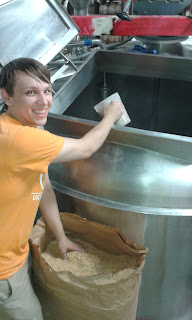
Richard adding rice hulls to the Mash Tun
Richard adding rice hulls to the Mash Tun.
I tried to take pictures throughout the day, but many of them didn't turn out because of the steam coming out of the kettle.  There was a student there filming and photographing the process, so I may get some of his pictures soon.
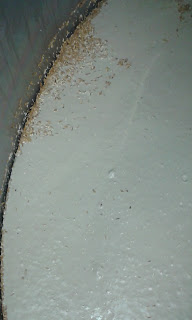
Protein cake
Protein cake.
I believe the above picture was taken during the final transfer of the turbid mash.  As you can see, a large layer of protein has developed on top of the grain bed (even separating away from the wall).  The next picture is the wort transferring over to the boil kettle.  They were very happy with how clean it was!

Transferring to boil kettle.
As the kettle was being filling, they started the boil.  It took nearly an hour to fill the kettle with 35 barrels of wort, and it was boiling the entire time.  During that time we added the hops.  We used 40 pounds of 5 year old Liberty hops.  They smelled like a hockey locker room.
5 year old hops for lambic
5 year old hops
Some people assume that Lambics don't have much hops in them, but there are IPA's that use less hops than Lambics.  The only difference is that they have been aged, which removes the bitter flavor of the hops, but retains its antimicrobial power.  The boil went for 4 hours.  Then the wort was transferred over to the whirlpool and left the hops behind.  Wow do those hops ever expand!
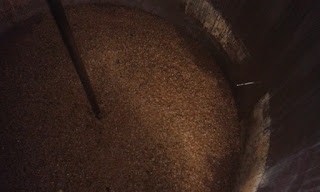
Hops at the bottom of the Boil Kettle
At this point that hops mass is about 8" deep and absorbing nearly 3 barrels of the wort.  Marc cleaned this tank the following day and told me they had puffed up and it was about 2 feet deep!

Installing the Drain Port:

While much of the brewing process was going on, I was further prepping the barrels.  We had to install the drain port prior to filling these barrels.  I talked to Vinnie at Russian River and he sent me over the instructions on how to do it.  Its always nerve racking drilling a whole into the barrel, so it was nice to know the exact method.
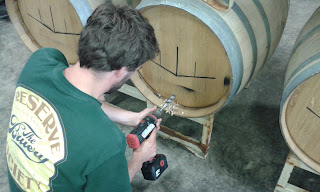
Drilling a 15/16" hole into the barrel head
Drilling a 15/16" hole into the barrel head.
15/16th inch hole drilled into barrel about 2 fingers up
The hole is about 2 fingers up from the edge.
A standard Belgian cork is inserted into the hole
Insert a standard Belgian cork into the hole.
It is quite simple.  The French Oak is pretty hard and can be a bit of a pain to drill through.  We tried a couple different ways of inserting the cork on our practice 2x4.  It is possible to hammer the cork in, but if you use a simple floor model corker, you can pull the handle part way so it just compresses the cork.  The cork has a bit of memory at that compressed state giving you enough time to easily slide the cork into the hole.  It will then quickly expand back to its normal state creating a very tight seal in the barrel.

Filling the Barrels:

So with the barrels prepped and the wort ready, it was time to fill the barrels.  Initially our plan was to short fill the barrels and then after the primary had finished, to rack over the contents of two of the barrels to top off the other 12.  As it happened, we had yielded more wort that estimated, and so we filled all 14 barrels to the top (stopping half way to add the yeast).
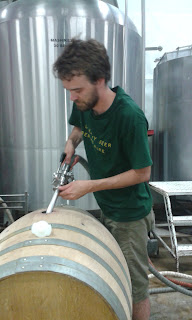
Filling the barrel with lambic wort
Filling the barrel with lambic wort.
Since this is the first use for these barrels, we needed to add a blend of yeast/bacteria to the barrel, which we did half way through filling each (1 liter of wort per barrel).  Future uses of these barrels will not require yeast to be pitched.  We used the same East Coast Yeast blend that I used for my pilot barrel.  I can't stress enough how happy I have been with this yeast.  Thank you Al!
Adding East Coast Yeast lambic blend to the barrel
Adding East Coast Yeast lambic blend to the barrel.
And so, 17 hours after we started, we have 14 barrels of lambic sitting over the drain waiting for fermentation to start.
14 lambic barrels full.  O'so Brewing & Funk Factory collaboration

I figured it would be 2 days before the fermentation kicked off, but Marc sent me this picture the next day:
Fermentation in less than 12 hours!

June 24, 2012

O'so Collaboration

Over the weekend I went up to start the preparation work for what will become a collaborative O'so/Funk Factory lambic project.

O'so Brewing Company
(click picture to visit the O'so website)

I arrived Friday evening to 14, French Oak, used wine barrels delivered and waiting for me.

14 French Oak used wine barrels


While I had the barrels on end, I decided to quick apply a stencil I made up for them.  Its a simplified version of the FF logo, and creates 4 spaces to record the fill date.  With that done, it was time to line up the barrels and fill them with water.

Oak barrels being filled with water to soak overnight


Soaking the barrel overnight was done for two reasons.  First, it will swell the barrel ensuring there are no leaks when it comes time to fill it with lambic wort.  Secondly, it will extract some of the wine flavor from the barrel.  In brewing lambic, you want as neutral of a barrel as possible.  When I arrived to the very last barrel and filled it up, I noticed it wasn't holding water.  On the barrel head opposite to me, it was gushing out water along the bottom croze.  I left the hose valve 1/3 of the way open, and it was losing water faster than the hose filled it.  Unfortunately, I think that barrel will need to be replaced even though it did swell up overnight.  I just don't have any confidence in a barrel that struggles that much to hold water that it will limit O2 permeation sufficiently.

The next morning I had to empty the barrels.  Moving around a 60 gallon filled barrel is no easy task, and in fact took me most the morning to empty all 14 barrels.  It wasn't until nearly noon that I started steaming the barrels.

Steam cleaning the barrels

This is the same steamer I used before.  Behind the barrel in the picture being steamed are 4 that I had already completed.  You can see the bung is in and seals the barrel.  As the steam cools down, it creates a vacuum that will extract more wine from the wood.  Once I finished with all the barrels, I gave them a final hot water rinse and sealed them again.  The air inside was hot from the water, so they will be vacuum sealed until the day we go to fill them with wort.


June 21, 2012

Sikaru Update

My barrel of "Sikaru" that I added dates to on Day 22 has a problem; acetobacter.  Acetobacter creates acetic acid, which in small amounts can be acceptable in lambic, but when oxygen is plentiful, the acetobacter will create too much.  This is exactly what has happened.

About 4 months ago you may remember that I waxed this barrel fearing it was getting too much oxygen.  I only waxed the top half where the head space is thinking the rest of the barrel should be fine.  Well, I was wrong.  This isn't to say you can't age a beer in a 5 gallon barrel.  My problem is that I got this barrel (for free) when I bought the 60 gallon barrel from a local winery.  He had kept the 5 gallon barrel on a display shelf for a couple years, so it was in very poor condition.  It wouldn't even hold water.  It took me a week to swell the barrel to a state that it could hold water.  Before filling, I steam cleaned the barrel thoroughly.  I assumed it was fine at that point, but I now believe the staves, while water tight, were not tight enough to slow O2 permeability sufficiently and there remained too much acetobacter in the wood even after the steaming process.  If you are going to use a barrel (of any size) make sure it has been properly maintained.  Also, if you are using a 5 or 10 gallon barrel, I would still recommend waxing the outsides to cut O2 permeation to a level comparable with the large 60 gallon barrels.

Last month I started a discussion on RateBeer talking about American Lambics vs. Belgian Lambics.  In my opinion, a higher acetic acid flavor profile is the norm from American Lambic producers.  It creates a more intensely sour flavored beer.  With the relatively young lambic drinkers in America, there is a mind set that the more sour a beer is means the better the beer is.  American brewers know this and some even keep a "sour barrel" handy that they blend into the final batch to increase the sour profile.  However, Belgian Lambics do not have much of any acetic acid flavor in their lambics.  I don't know if they go as far as to call it an off flavor, but I personally do.  I don't care for it in my lambics.

At this point, this barrel is useless to me.  With a healthy supply of O2, acetobacter will continue to convert alcohol into acetic acid.  Allowed to continue, I will have vinegar.  Maybe I'll make a mustard with it?

May 8, 2012

Barrel Notes: Day 102

The main point of this update was to check on the pellicle.  As I mentioned in Barrel Notes: Day 60, the pellicle had appeared to be clearing up.

To recap, here is the progression of the pellicle:

Day 17
Day 22
Day 34
Day 60

And now today:
Day 102

It appears that things are starting to develop again on the surface.  I'm still not sure what is going on.  I like that it appears to be forming a pellicle again as I intend to age this barrel for 3 years and a strong pellicle will help cut any O2 exposure in the head space.  I spoke with Vinnie at Russian River before I got home today, so only had the first 4 pictures to go off of.  He had some good things to say, but no real definitive "this is what's going on" answer.  He recommended asking the folks on Babble Belt, so that's what I'll do.  Feel free to read and join in on the conversation over there.

I didn't take a sample out this time, but it smells fantastic...

Google Analytics