 |
| Lambic pellicle at day 277. |

Showing posts with label Pellicle. Show all posts
Showing posts with label Pellicle. Show all posts
October 30, 2012
Barrel Notes: Day 277
Just a quick update as I had to open the barrel to take a measurement of the bung. While it was open I decided to snap a picture:
And wow! It smells amazing. It smells like it would be very good to drink already. I've always seemed to be pretty good with the patience and waiting game, but this is going to be tough.

May 8, 2012
Barrel Notes: Day 102
The main point of this update was to check on the pellicle. As I mentioned in Barrel Notes: Day 60, the pellicle had appeared to be clearing up.
To recap, here is the progression of the pellicle:
It appears that things are starting to develop again on the surface. I'm still not sure what is going on. I like that it appears to be forming a pellicle again as I intend to age this barrel for 3 years and a strong pellicle will help cut any O2 exposure in the head space. I spoke with Vinnie at Russian River before I got home today, so only had the first 4 pictures to go off of. He had some good things to say, but no real definitive "this is what's going on" answer. He recommended asking the folks on Babble Belt, so that's what I'll do. Feel free to read and join in on the conversation over there.
I didn't take a sample out this time, but it smells fantastic...
To recap, here is the progression of the pellicle:
 |
| Day 17 |
 |
| Day 22 |
 |
| Day 34 |
 |
| Day 60 |
And now today:
 |
| Day 102 |
It appears that things are starting to develop again on the surface. I'm still not sure what is going on. I like that it appears to be forming a pellicle again as I intend to age this barrel for 3 years and a strong pellicle will help cut any O2 exposure in the head space. I spoke with Vinnie at Russian River before I got home today, so only had the first 4 pictures to go off of. He had some good things to say, but no real definitive "this is what's going on" answer. He recommended asking the folks on Babble Belt, so that's what I'll do. Feel free to read and join in on the conversation over there.
I didn't take a sample out this time, but it smells fantastic...
March 27, 2012
Barrel Notes: Day 60
Wow, already 2 months in. Last time I took a gravity reading was Day 9, so I thought the 2 month mark was a good time to do it again.
This is about what I expected. What I didn't expect was the color of the beer. If you compare that to when I got the wort (far right in this image), you can see there has been a huge change. It use to be dark brown, and now is orange. I wasn't sure why this happened, so I asked expert home brewer Jay (aka Fear025):
Now on to the pellicle, here is a picture of it from today:

This I find odd. Compare that picture to the image from Day 34, and then to the one from Day 22. Its almost as if the pellicle is clearing up. I have read that the brett will eat the pellicle, but I thought that is something that would occur very late in the aging process and at a minute scale. Any ideas as to what is going on? The only other thing I can think of is that the weather has been very warm lately, which should have kicked in the pedio stage. Is this the beginnings of my beer turning "ropy"? I hope so!
 |
| Gravity reading: 1.010 |

The wort was dark because there were caramelized particles suspended in the liquid. As time passed, gravity pulled those particles downward to settle at the bottom of the vessel.Pretty simple answer really. I wasn't really worried about the color, but it is nice to know it will clear up to a more traditional lambic color.
Now on to the pellicle, here is a picture of it from today:

This I find odd. Compare that picture to the image from Day 34, and then to the one from Day 22. Its almost as if the pellicle is clearing up. I have read that the brett will eat the pellicle, but I thought that is something that would occur very late in the aging process and at a minute scale. Any ideas as to what is going on? The only other thing I can think of is that the weather has been very warm lately, which should have kicked in the pedio stage. Is this the beginnings of my beer turning "ropy"? I hope so!

March 1, 2012
Barrel Notes: Day 34
Checking in on the pellicle again. Here is how it looks:
Comparing that to the previous picture, the pellicle has gotten denser over the last couple weeks. The aroma hasn't changed much, but I am getting a bit of an almost tropical fruitiness. Still very funky and still quite a bit of lacto. It's encouraging to have a wide range of aromas already.
February 18, 2012
Barrel Notes: Day 22
I have checked in on the pellicle again as I am interested to see it during different stages of development. Here is a picture of its current state.

As compared to the picture in my previous post, it appears as if little colonies have developed. The aroma coming from the barrel is increasingly funky.
You may remember that in addition to the 225 liter barrel, I had enough wort left to fill a small 5 gallon barrel. To ferment the 5 gallon barrel, I used an assortment of commercial sour dregs collected at a beer tasting event. It is interesting to compare the pellicle formed in the big barrel (above) to that of this 5 gallon barrel (below).

There are a few major factors that cause such a different pellicle formation between the two barrels. The primary factor would be the different yeast source. Another factor is the 5 gallon barrel has higher oxidation due to greater surface area with the oak. In addition, there was only about 4 gallons remaining to fill the 5 gallon barrel, so it is a relatively short fill resulting in a larger head space. This head space has theoretically been filled with CO2 during the primary fermentation phase, however I do not doubt a certain amount of oxygen was present as well.
I don't want that much head space in the 5 gallon barrel during the aging process. After some consideration on what to do, my plan for this 5 gallon barrel is to make the Sikaru I talked about earlier. To do this, I will be adding dates and honey to the lambic. The rule of thumb in fruiting lambic is 2lbs of fruit per gallon of lambic, so I will be requiring 8-10 pounds of dates. Normally fruiting is done a few months prior to bottling, however, I will be adding a portion of the dates now to eliminate the unwanted head space in the barrel.

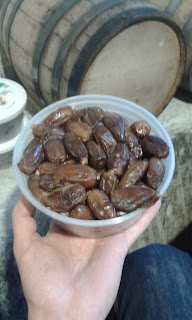
I purchased 4.5 pounds of whole dates. I'm not 100% sure the reason behind using whole fruits, however I know Cantillon and others insist on it, and so I made sure to follow suit.

I wanted to wait until primary fermentation had ended to add the fruit, but make sure they were added before the aging stage started. With the amount of sugar in dates, and the amount of dates I added, I wouldn't doubt if I saw a reasonably strong second fermentation. I'm not worried that I've damaged the existing pellicle (and of a second fermentation damaging it further). It was not dense enough to fall, and the disturbed area will grow back in short time.
As compared to the picture in my previous post, it appears as if little colonies have developed. The aroma coming from the barrel is increasingly funky.
You may remember that in addition to the 225 liter barrel, I had enough wort left to fill a small 5 gallon barrel. To ferment the 5 gallon barrel, I used an assortment of commercial sour dregs collected at a beer tasting event. It is interesting to compare the pellicle formed in the big barrel (above) to that of this 5 gallon barrel (below).

There are a few major factors that cause such a different pellicle formation between the two barrels. The primary factor would be the different yeast source. Another factor is the 5 gallon barrel has higher oxidation due to greater surface area with the oak. In addition, there was only about 4 gallons remaining to fill the 5 gallon barrel, so it is a relatively short fill resulting in a larger head space. This head space has theoretically been filled with CO2 during the primary fermentation phase, however I do not doubt a certain amount of oxygen was present as well.
I don't want that much head space in the 5 gallon barrel during the aging process. After some consideration on what to do, my plan for this 5 gallon barrel is to make the Sikaru I talked about earlier. To do this, I will be adding dates and honey to the lambic. The rule of thumb in fruiting lambic is 2lbs of fruit per gallon of lambic, so I will be requiring 8-10 pounds of dates. Normally fruiting is done a few months prior to bottling, however, I will be adding a portion of the dates now to eliminate the unwanted head space in the barrel.


I purchased 4.5 pounds of whole dates. I'm not 100% sure the reason behind using whole fruits, however I know Cantillon and others insist on it, and so I made sure to follow suit.

I wanted to wait until primary fermentation had ended to add the fruit, but make sure they were added before the aging stage started. With the amount of sugar in dates, and the amount of dates I added, I wouldn't doubt if I saw a reasonably strong second fermentation. I'm not worried that I've damaged the existing pellicle (and of a second fermentation damaging it further). It was not dense enough to fall, and the disturbed area will grow back in short time.
February 13, 2012
Barrel Notes: Day 17
I can't help buy go down and smell the barrel every couple days (the aroma had been gradually declining since that Day 4 post). It has been a few days since I have checked in on the barrel, and not expecting much I was surprised by the burst of new aroma. Its still got a sour note, but now there is some funky aromas going.
I grabbed my flashlight to see how it looks, and to my delight, a thin pellicle has formed!

Those of you follow this blog know what a pellicle is, and know its a crucial part of the lambic brewing and aging process. This is sooner than I expected the pellicle to form, but honestly I didn't know when to expect it. I am going to declare the primary fermentation as complete and bung the barrel.
I grabbed my flashlight to see how it looks, and to my delight, a thin pellicle has formed!
Those of you follow this blog know what a pellicle is, and know its a crucial part of the lambic brewing and aging process. This is sooner than I expected the pellicle to form, but honestly I didn't know when to expect it. I am going to declare the primary fermentation as complete and bung the barrel.
February 6, 2012
Installing a sample port
A week of fermentation has gone on and I'd like to get a sample of the beer to take some measurements. I could simply put a wine thief through the bung hole and take out a sample, however, I need to be thinking long term. Eventually a pellicle will form on the top of this beer, and I won't want to disturb it. The best way for me to do this is to install a sample port on the head of the barrel.
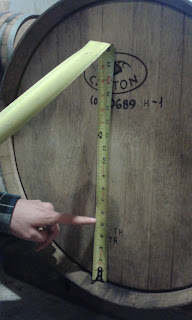
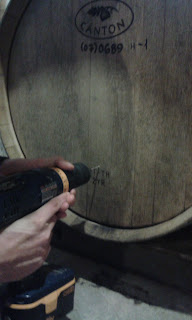


The best and easiest way to do this is to drill a small hole and plug it with a stainless steel nail. Because its so cheap, easy, and effective, this method seems to be the industry standard. If you are having any doubt, there is a thread on Probrewer with some brewers talking about this, and I remember seeing the guys out at Lost Abbey doing this.
Its important to use a stainless steel nail as you don't want the nail to corrode while in the beer. This is especially true when doing an acidic beer such as Lambic. I was thinking a copper nail would be fine as well, but after reading a couple sites, it seems copper leaches at a high level when in an acidic environment...so I would suggest against using copper.

There is no exact spot that is suppose to be drilled. It should be high enough up so that you are above the trub, but low enough to ensure static pressure behind the hole. I went up 5" from the bottom.

The size of bit is also very important. Too small, and the nail will slide out. I used a 7/64" bit as recommended in the Probrewer thread.

It comes out fast and shoots pretty far! Make sure you have a container of some sort ready.

And there is the final product. The only stainless steel nail available at the hardware store was a 2 1/2" one. You could use smaller, but its kind of nice having a longer nail.
January 4, 2012
Pellicle
The skin. The pellicle is the thin layer that forms on the top of the wort. It occurs when yeast, especially brett, come into contact with oxygen. The first time you see it, it looks a little scary. But once you come to understand what it does, its kind of neat.

The pellicle looks like it would be bad for the beer, but in actuality its very good. A lot of things happen during the lambic brewing process as sort of a "self-check" or corrective measure, this is one. The yeast likes a little oxygen, but not a lot. It forms this protein based skin to separate the wort from the oxygen. The pellicle also protects the wort from unwanted bugs such as acetobacter that would just destroy the beer and turn it into vinegar. Take another look at the picture. Its kind of pretty isn't it?

The pellicle looks like it would be bad for the beer, but in actuality its very good. A lot of things happen during the lambic brewing process as sort of a "self-check" or corrective measure, this is one. The yeast likes a little oxygen, but not a lot. It forms this protein based skin to separate the wort from the oxygen. The pellicle also protects the wort from unwanted bugs such as acetobacter that would just destroy the beer and turn it into vinegar. Take another look at the picture. Its kind of pretty isn't it?
Subscribe to:
Posts (Atom)